The Era of Decision Games
People say AI will take your job. They're wrong. It will take your tasks, and leave you with something harder: the decisions.
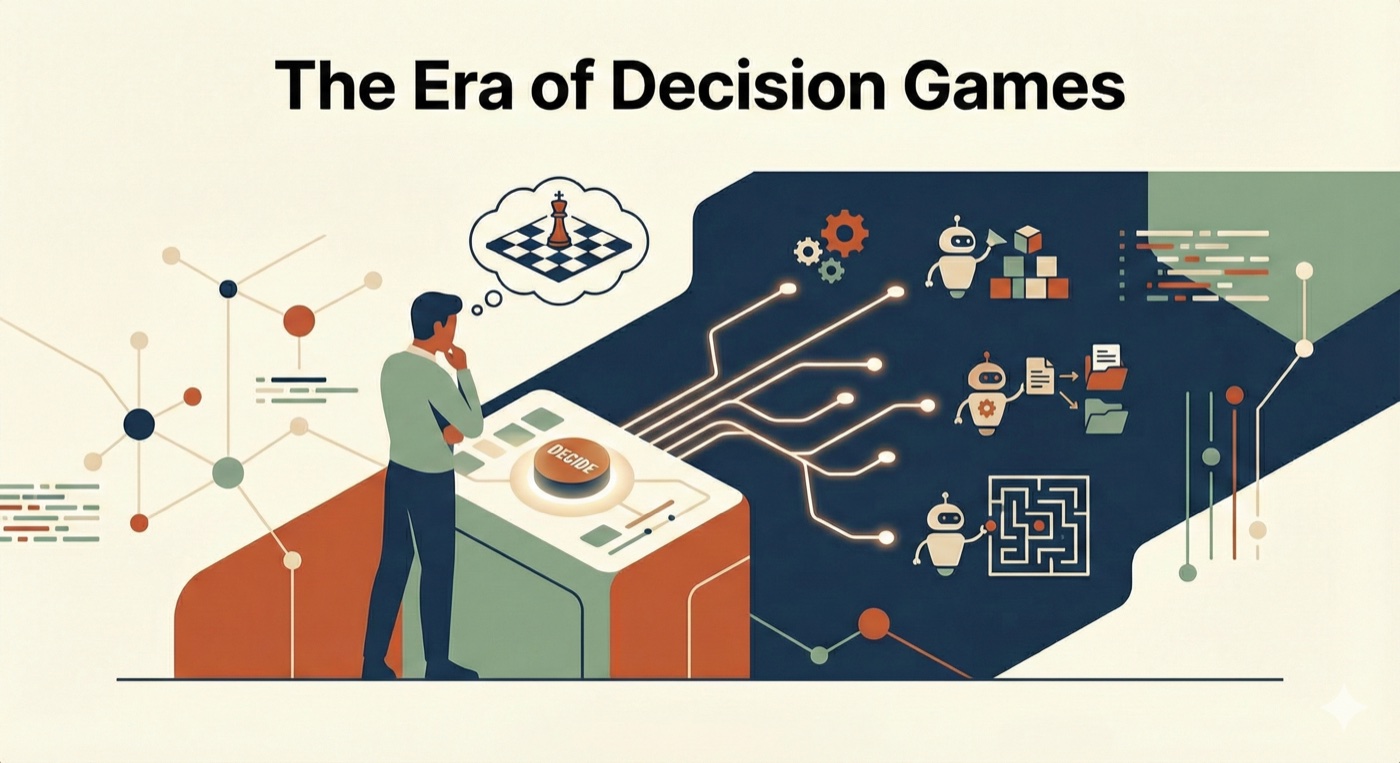
Picture this: you ask an agent to "clean up one endpoint." Ten minutes later it has touched dozens of files, rewritten authentication logic, updated tests, and asks one final question: "Do you want the safer version, or the faster version?"
That is the new bottleneck. Not typing. Not building. Deciding.
2026 kicked off with an explosion of autonomous AI agents, closer to Jarvis than ever, as they came alive on people's computers. The launch of OpenClaw has introduced millions of "Clawds" that run across various platforms, from MacMini and PC boxes to Raspberry Pi, and quickly spawned a wave of variants, NanoClaw, PicoClaw, and IronClaw. Simultaneously, major Foundational Models—such as Claude, GPT, and Kimi—have become more agentic than ever, fundamentally incorporating Agent Swarm or Agent Team capabilities.
This is, in many ways, the natural culmination of 2025, which, thanks to the AI community's collective efforts, lived up to its promise as the year of AI agents. With products like Manus, Claude Code, and OpenClaw demonstrating advanced autonomy, such as navigating environments, managing cross-application logic, and self-correcting, execution fundamentally transforms into a zero-marginal-cost commodity.
In this new era, deploying thousands of 'digital specialists' renders the ability to build, code, or execute tasks no longer a key challenge or competitive advantage. Many people say AI will take your job. They're wrong. It will take your tasks, and leave you with something harder: making the decisions.
"AI is commoditizing execution. What remains scarce, and what will define this coming era, is the quality of human decision-making.
The Decision Game
The paradigm shift first started within software development. The entire industry is on an unstoppable trajectory of change, moving away from manual coding entirely.
The shift happened in a mere three years. Developers moved from copying and pasting code from ChatGPT in 2023 to relying on Cursor's effective autocomplete by mid-2024. This quickly accelerated to accepting batched changes from agents like Cursor Agent, and finally, with the arrival of Claude Code, they stopped writing any line of code entirely, and stepped into a true point of no return for the profession.
This acceleration exposes a critical mismatch between Computer Science education and the new demands of the developer job. For years, the old game was to learn craft, mastering basic algorithms and practicing competitive coding like LeetCode. Now, a single prompt can generate high-quality implementations of most algorithms and data structures. The new challenge, and the new game, is judgment: deciding the right way to prompt an AI to get a working version of the Ford–Fulkerson algorithm to solve the maximum volume of traffic a city's road network can handle.
While coding agents have empowered everyone to write software more productively, veteran developers achieve 10x-100x quality and speed not just by coding, but by making superior design decisions, feature choices, architecture, and tradeoffs. The proof is in the products: Manus was built by seasoned engineers from the Chinese AI ecosystem, Lovable was created by experienced designers who understood what users actually need, and even OpenClaw traces back to veteran developers with deep systems expertise. The breakout successes come from people who already knew what to build—agents just let them build it faster.
This trend is spreading beyond software. Agents like Shortcut AI (spreadsheets, already stirring controversy at the Excel World Championship), Claude Cowork (knowledge work), Manus (general-purpose agent), and Composer (browser automation) are entering various fields.
This shift elevates human effort from the low-level mechanics of execution to the high-level art of orchestration and decision making. In the recent documentary The Thinking Game, Demis Hassabis describes the pursuit of AGI as exactly that — a thinking game.
Now, when AGI is approaching our daily life, how to leverage, orchestrate, and use the intelligence machine is a Decision game.
The pursuit of AGI is the Thinking Game. The mastery of AGI will be the Decision Game.
Winning the Decision Game
For decades, certain industries have cultivated decision-making skills, giving rise to the discipline of Decision Science. However, quality training in this area has historically been limited to privileged groups or specific professions, not widely available.
Consider the world of hedge funds and trading firms, for example. The lore is filled with tales of legendary traders who made significant, profitable bets. These individuals might not be the most technically proficient; they often hire software engineers and analysts for tasks like data collection and analysis. Yet, because the trader ultimately makes the critical market decision, they claim the largest share of the profit.
This exclusivity is changing. The era of decision-making being the sole privilege of traders or leaders is ending. In the coming years, everyone will have their own "agents" to execute tasks, leading to widespread efficiency gains.
"Efficiency without a sense of direction is merely high-speed entropy.
What makes one a good decision maker?
The core elements of effective decision-making are:
- Intuition: The heuristic power to select the optimal path from a multitude of independent options, particularly when data is unclear and the consequences are significant.
- Taste: The capacity to define what constitutes an "excellent" outcome even when the goalposts are in flux.
- Knowledge: Deep, specialized understanding of the domain essential for making informed decisions.
An obsession with finding a "secret sauce" to becoming a superior decision-maker is a common pitfall. It mirrors the tendency to idolize successful people, suggesting they possess some mysterious, innate quality. As a cognitive psychologist, I believe this notion is vastly overblown. While certain heuristics are difficult to articulate, the capacity for good judgment is absolutely trainable.
Deep Knowledge is the True Foundation
A critical, often overlooked, element is deep knowledge. Highly effective decision-makers, such as successful market traders, first gain an intimate understanding of the market, its structure, and its participants before forming any insights. This profound knowledge allows them to make sound decisions even when faced with new, imperfect, or partial information.
Leaders lacking deep knowledge are easily manipulated and fooled by subordinates, leading to poor decisions. Consider the case of Meta and Mark Zuckerberg's decision-making regarding LLM talent, which contributed to the failure of LLAMA 4. Now, contrast this with the foundational success of DeepMind's Demis Hassabis, Anthropic, early OpenAI, and even Elon Musk’s XAI. If your goal is to develop excellent "taste" and form solid judgment, deep knowledge is the non-negotiable foundation.
Acquiring Deep Knowledge is More Accessible Than Ever
Gaining deep knowledge is simpler now than at any point in history. It only requires focused, diligent study. You must actively seek out all available resources to educate yourself. There is no hidden, mystical knowledge about human nature or the world that cannot be learned.
The current generation of tools, especially Large Language Models (LLMs) and agents, are the best teachers available. They are knowledgeable, infinitely patient, and will never hesitate to encourage you, "you are absolutely right."
Therefore, the most effective strategy for improving decision-making is to intentionally cultivate a learning environment and a robust feedback loop: Make a decision, observe the outcome, update your judgment, learn new knowledge, and make decisions again.
Toward a Society of Better Decision-Makers
The advancement of AI should benefit everyone, improving the lives of all people, rather than being confined to a privileged elite or a small Silicon Valley circle. There is vast potential to build and innovate using the power of AI.
More Environments for Agents, further reducing execution cost
The digital world currently limits AI agents. Existing infrastructure is built for rigid, programmatic systems or human interaction, leaving agents, a new digital "species" that consumes information and acts within the digital world, constrained. While AI intelligence (the "brain") is advancing steadily and rapidly, the environment enabling its full potential remains underdeveloped. The long-standing dominance of the human-to-AI chatbot model is outdated, feeling like a relic from the 1960s, offering little innovation beyond systems like Eliza.
Consequently, a significant focus in new software development must shift to creating supportive environments for these agents. This will allow them to automate more tasks for humans and continue to drive down execution costs.
The Human Interface that improves decision making quality
As AI Agents become exponentially more efficient, the critical challenge shifts to the Human-Agent Interface. Since agents can generate content 100 times faster than a person can consume and verify it, and human consumption speed increases very slowly, traditional interfaces are destined to fail. This imbalance will only lead to human exhaustion and force people to serve the AI, resulting in a dystopian outcome.
Therefore, superior interface design must offer human affordance. In this new era, the primary affordance is empowering humans to make decisions more easily and effectively.
What would such an interface look like? I believe it must do five things well:
- Surface only the essential decisions — resolve the trivial ones autonomously, and present the human with the choices that actually matter.
- Be transparent and auditable — give even non-technical users a clear trail of every decision made.
- Provide robust guardrails — self-correction mechanisms that catch errors before they compound.
- Communicate confidence honestly — so users know when the agent is certain and when it is guessing.
- Support contingency thinking — the ability to roll back a faulty decision, or to explore "what if" branches before committing.
Above all, the interface should be designed to optimize decision-making, not task execution. As agents mature and earn trust, the interface should simplify. The intricate details will only matter for debugging, not for daily use.
An Invitation to the New Era
In 1959, John McCarthy envisioned a system called the Advice Taker in his paper, "Programs with Common Sense."McCarthy, J. (1959). Programs with Common Sense. Proceedings of the Teddington Conference on the Mechanization of Thought Processes, pp. 75–91. This paper is widely considered the first proposal to use logic for knowledge representation in a computer program. Instead of detailed, step-by-step programming, the Advice Taker would operate by accepting declarative facts and rules as initial knowledge, then using logical deduction to determine the necessary course of action. Its function was to take a goal and relevant information and autonomously reason through the intermediate steps—mirroring how a person processes advice to decide what to do.
That concept is now a reality. While not a formal logic engine as McCarthy described, the spirit of the Advice Taker lives on in modern systems. These technologies take your intention, knowledge, and judgment and translate them into action, handling the intermediate reasoning, execution, and difficult labor on their own.
The new focus shifts to us. The challenge is to provide superior "advice", to infuse these machines with the taste, judgment, and deep knowledge they cannot yet generate. This is how we ensure that our lives, and the lives of future generations, are not just more productive, but profoundly more human.
I invite you to step into this decision game as a builder, a thinker, and a decision-maker. Learn deeply, decide deliberately, and use agents as force multipliers for what you believe should exist.
Your decisions are now the product.